
How does Air Traffic Control work?
- number and type of aircraft operating at the airport
- length of runway(s)
- weather conditions (both present and forecast) - including wind velocity and gradient, wind shear, wake turbulence effects and position of the sun
- availability of approach aids in poor visibility conditions
- location of other aircraft
- taxiing distances, including availability of taxiways
- braking conditions.
- number and type of aircraft operating at the airport
- length of runway(s)
- weather conditions (both present and forecast) - including wind velocity and gradient, wind shear, wake turbulence effects and position of the sun
- availability of approach aids in poor visibility conditions
- location of other aircraft
- taxiing distances, including availability of taxiways
- braking conditions.
What does Air Traffic Control do?
Air traffic controllers keep aircraft at safe distances from each other in the air and on the ground, arranging them in an orderly flow for landing or take-off along defined flight paths.
We use specialised radar, communication and navigation systems and processes to allow aircraft to fly safely in our skies.
Air traffic controllers provide information to aircraft, pilots and crew, such as:
Separation: we keep aircraft a minimum vertical or lateral distance apart and tell them when they can safely go ahead, go higher, lower or change direction.
Flight information: advice and information such as weather, runway conditions and hazard warnings to ensure safe and efficient flight.
Traffic information: advice and alerts to pilots about other aircraft positions, speeds and intended routes.
Different types of air traffic controllers manage aircraft through all phases of flight, from the departure gate before take-off to the arrival gate at the other end of the journey, and everything in between.
Types of Air Traffic Control at Sunshine Coast Airport
Air Traffic Control Tower: The Tower Controllers are located at Sunshine Coast Airport’s Air Traffic Control Tower and are responsible for all aircraft and vehicle movements on taxiways, runways and in the immediate vicinity of the airport. Tower controllers watch aircraft through the tower windows to ensure they stay safely separated and also use a range of technology to assist with this.
Air Traffic Service Centre (ATSC): Terminal and En route controllers operate from the Air Traffic Service Centre (ATSC) in Brisbane. These controllers use surveillance technology to manage the flow of arriving and departing aircraft in an extended area around major city airports, across the Australian mainland and on oceanic routes within Australia’s flight information region. ATSC controllers are instrumental in maximising the safe use of this busy airspace.
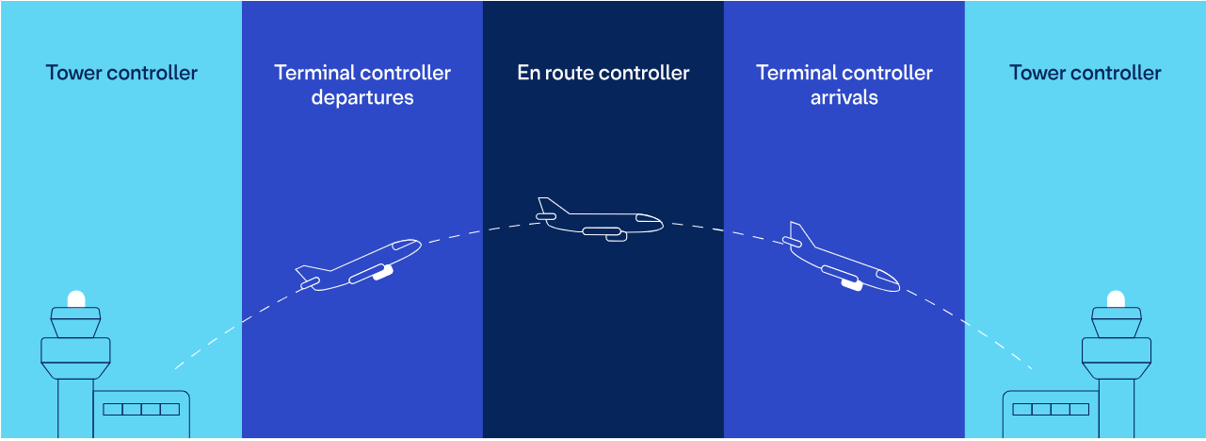
How does Air Traffic Control work at Sunshine Coast Airport for arriving aircraft?
Once the aircraft departs the runway from its origin and is securely in the sky, the ATSC controller will be communicating with the pilot and crew, to ensure that it safely traverses towards its destination.
As the aircraft nears Sunshine Coast Airport, the ATSC Controller will hand over to the Sunshine Coast Tower. The Tower controller will take over communications with the crew and direct the aircraft to approach the Sunshine Coast airspace via a specific arrival path.
The arrival path that the Tower controller specifies depends on a number of factors, such as the type, weight and capability of the aircraft, the weather conditions, the amount of air traffic in the vicinity, and the runway which it will land on.
When deciding which runway to use, the Tower Controller will consider the following factors:
The Tower Controller will clear the aircraft to land on the active runway and direct the pilot to the arrival gate via a safe taxiway.
How does Air Traffic Control work at Sunshine Coast Airport for departing aircraft?
Once the aircraft is ready to leave the departure gate, the Tower Controller will direct it to the runway via a taxiway. The Tower Controller will select which runway is suitable to depart from, considering a number of factors which include:
As the aircraft takes off and stabilizes into its flight, the Tower Controller guides the aircraft out of the vicinity of the airport, making sure that it is safely separated from other aircraft.
Once the aircraft is securely in the sky, the Tower Controller will hand over to the ATSC Controller, who communicates with the pilot and crew, ensuring that it travels safely to its destination.
What happens when the Air Traffic Control Tower at the airport is closed?
Air Traffic Control towers don’t all operate 24 hours a day. The tower at Sunshine Coast Airport operates from 7am to 7.40pm (local time). Outside these hours, the airspace immediately surrounding the airport (up to 4,500ft above the runway) is classified as “uncontrolled”.
While the term “uncontrolled” may sound alarming, pilots are not flying unaided, it just means that they aren’t being directly managed by air traffic controllers. Pilots have access to a radio information service known as AWIS (Automatic Weather Information Service). AWIS is an automated broadcast providing current weather conditions.
Pilots also have their own radio band, which is called Common Traffic Advisory Frequency (CTAF), to coordinate among themselves to share information so they remain safely separated from each other.
Even when the tower is closed, the broader airspace is still managed by ATSC controllers.
Arriving when the Air Traffic Control Tower is closed
Aircraft arriving when the tower is closed are guided by the ATSC Controller to safely enter the airspace around the airport. Once the aircraft has descended to 4,500ft, the pilot will switch to the CTAF broadcast, however by this point most large aircraft will already be on a specific approach path and aligned to the runway, preparing to land.
Departing when the Air Traffic Control Tower is closed
When an aircraft is departing outside tower hours, the pilot listens to the AWIS broadcast and makes an informed decision as to the runway to use and departure path to take. Once the aircraft has taken off and reaches an altitude of 4,500ft, the ATSC Controller then guides the pilot outside of the airspace and towards their destination.